


In my last post I mentioned solar thermal energy technology. I thought I must mention how solar thermal is different to the photovoltaic solar cells that readers may be familiar with.
While photovoltaic cells directly use the sun’s light to create electricity, solar thermal installations use mirrors to concentrate the heat from the sun into a storage medium, such as molten salt. The high heat of this molten salt can then be used to turn a turbine by boiling water into steam, much like what happens in a coal, gas or nuclear power plant. The benefit of solar thermal over photovoltaics is that it can be relied upon as a baseload, 24 hour power source as heat is gradually drawn from the molten salt when required. The benefits of solar thermal over coal, gas and nuclear is that it requires no fuel inputs, and emits no pollution from its operations.
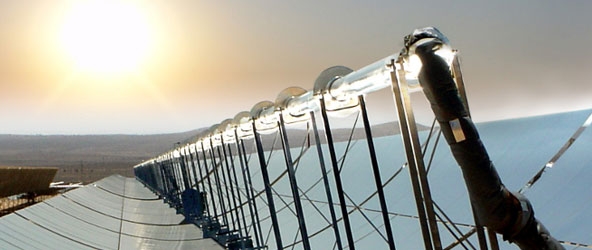
I’m sure I’m not the only one excited by technology such as this. I’m fascinated by the idea of energy sources that need no fuel inputs and produce no pollution or emissions. Better yet, the cost of solar thermal is comparable to coal power plants and the technology is well-suited to Australian conditions. Bring it on.
A quote from page 87 of The Ecology of Commerce (1993) by Paul Hawken:
Solar technologies are currently more expensive than coal because they internalise their costs to the environment, but coal externalises its costs.
I think it’s great that despite this situation (the costs of coal pollution to the environment being written off as ‘free’), solar thermal is still emerging as an economic challenger to coal under these ‘old rules’. When we remember that coal is only ‘cheap’ because of the incomplete way we account for its environmental lifecycle, the choice between fossil fuels and renewables is stark. Let’s make our priority supporting clean, rapidly deployable technology such as solar thermal.
Tags: energy, renewable, solar, solar thermal
I really like it whenever people get together and share ideas.
Great website,continue the good work!
I loved as much as you’ll receive carried out right here.
The sketch is tasteful,your authored material stylish.
nonetheless, you command get bought an edginess over that you wish
be deliverring the following. unwell unquestionably
come further formerly again since exsactly the same nearly a
lott often inside case you shield this hike.
Here iss my homepage why social media
Hi Logan,
That’s a very simplistic statement. It’s not clear whether you are talking about solar thermal or solar photovoltaic – or even whether you understand the difference. It’s also quite ambiguous as to what you define as “very” efficient.
If you’ve read Stuart’s post, you will realise that solar thermal uses essentially the same turbines that conventional power stations use, and hence achieves effectively the same energy conversion efficiency.
If you’re talking about solar photovoltaic, then currently the efficiency is lower than solar thermal, because photovoltaic panels utilise only part of the light spectrum. However, making up for this is the fact that it can be manufactured at household scale, and located at the point of use. This enables cost efficiency gains by not requiring additional land and transmission infrastructure.
And of course, through all of this it is important to ask what “efficiency” really means – bearing in mind that the cost of fossil fuels is increasing and the cost of sunlight is zero.
david
Hi Stuart,
For some great pics of solar thermal, do a google image search for solar power tower. There’s some nice looking ones with arrays of mirrors all beaming sunlight up to the central tower.
And from side-on the pics capture a kind of angelic glow 🙂
david
Pingback: Stuart McMillen » Blog Archive » 100% renewables in 10 years