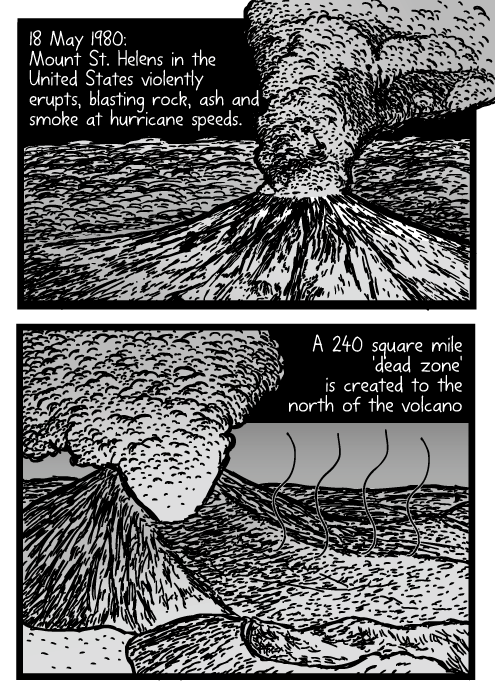
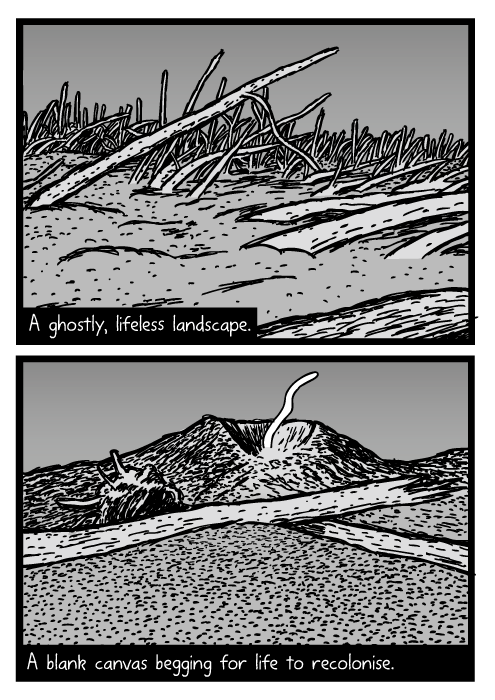
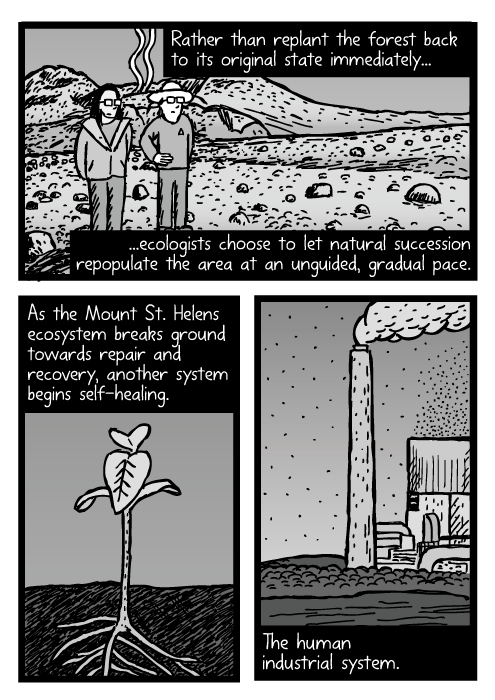
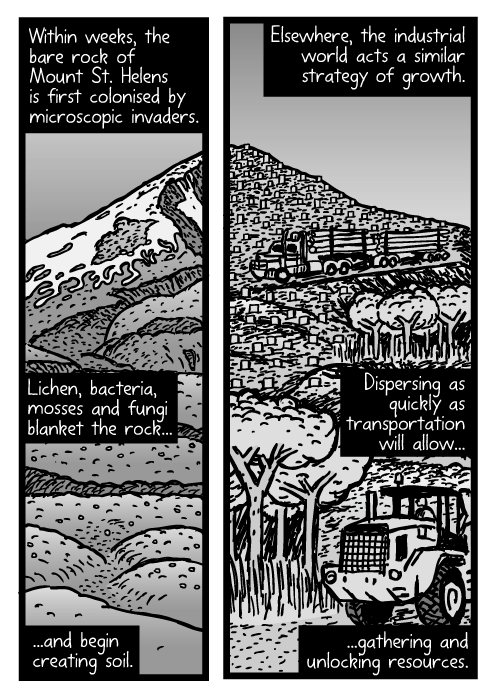
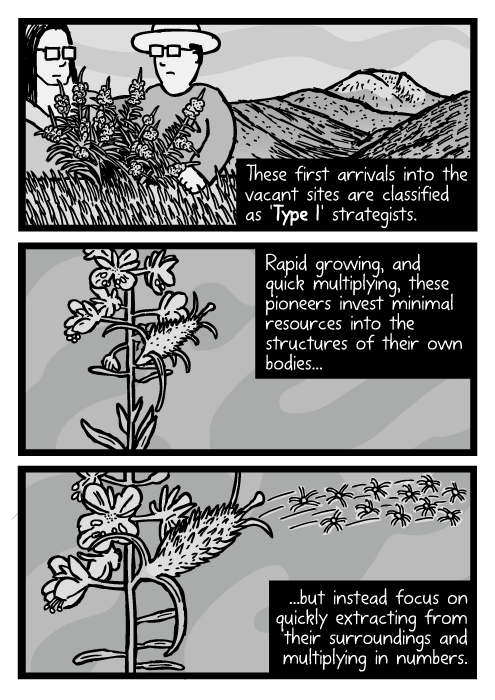
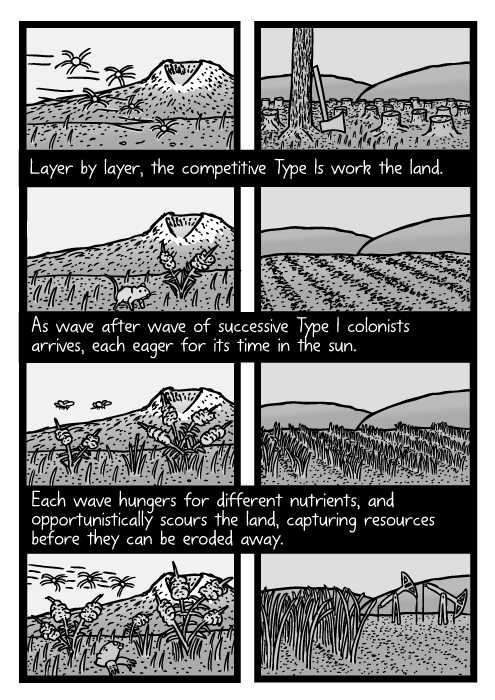
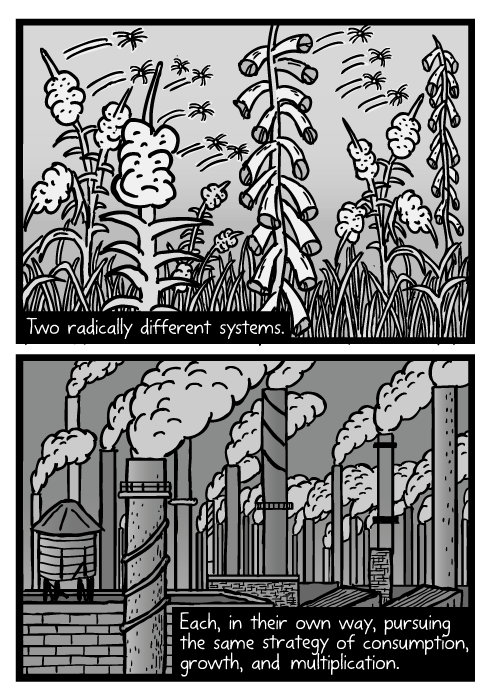
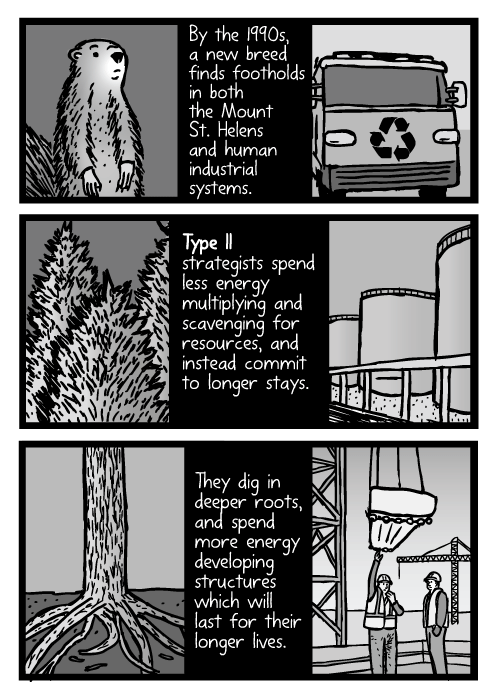
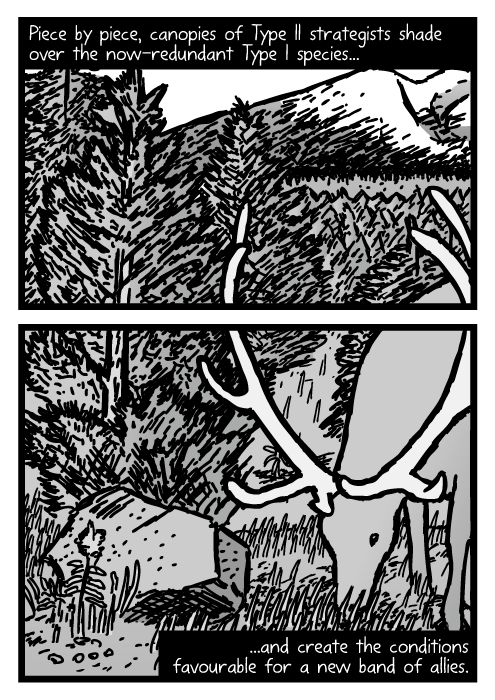
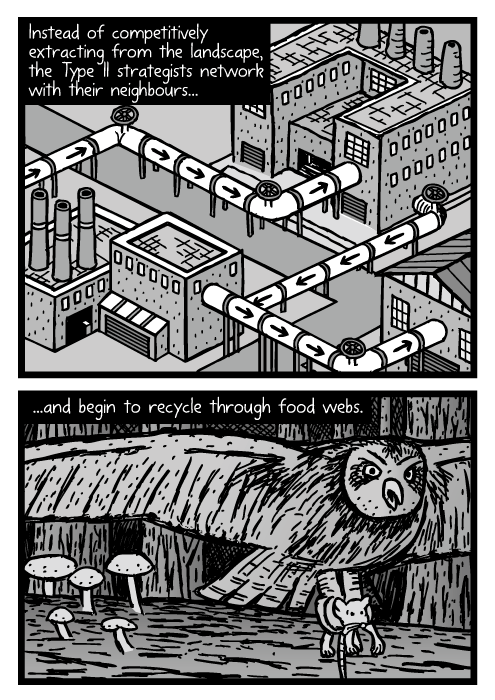
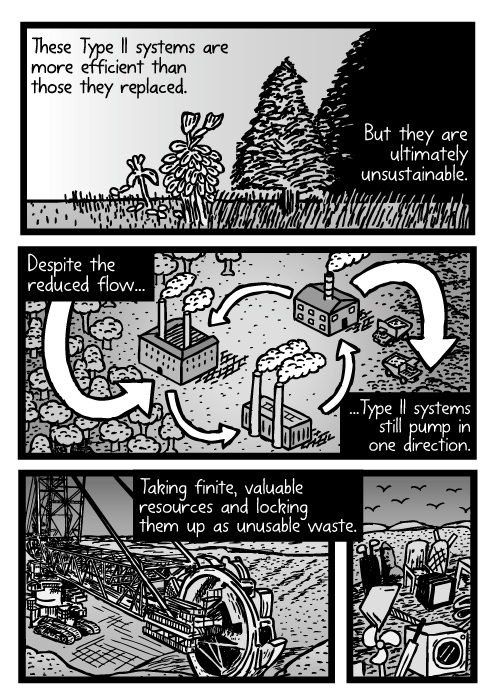
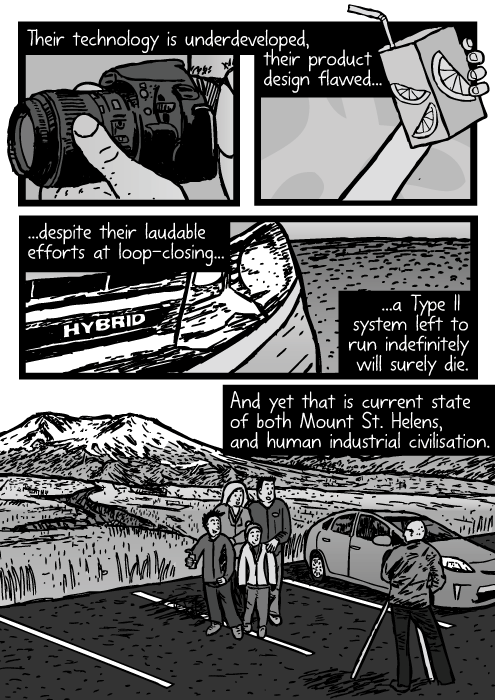
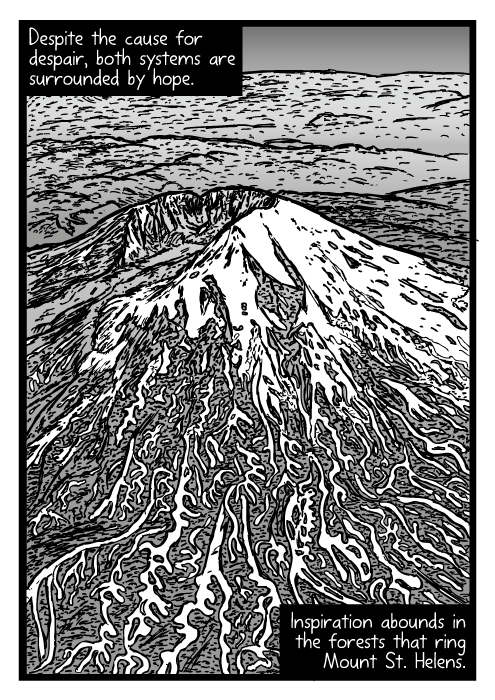
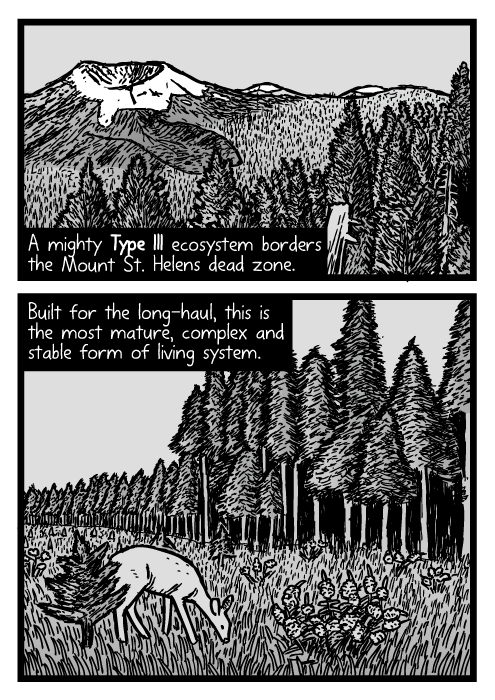
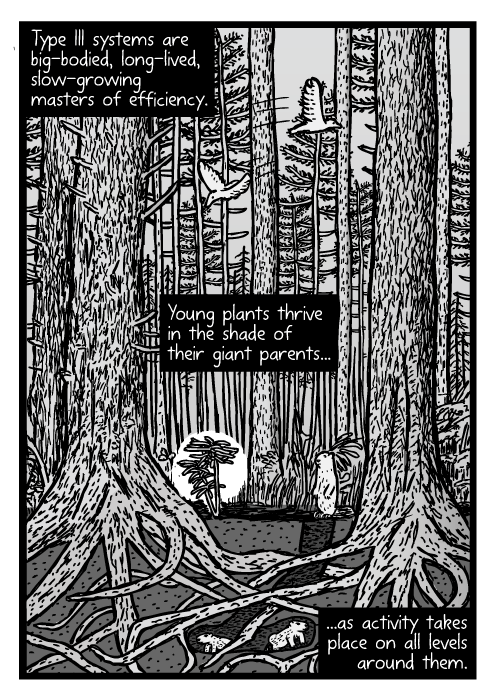
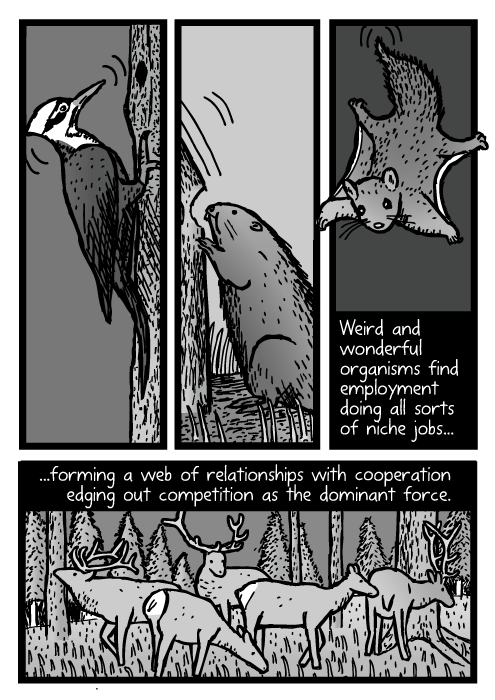
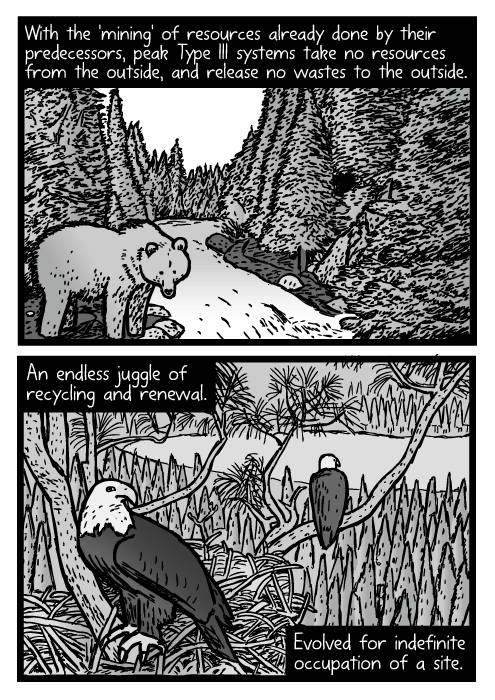
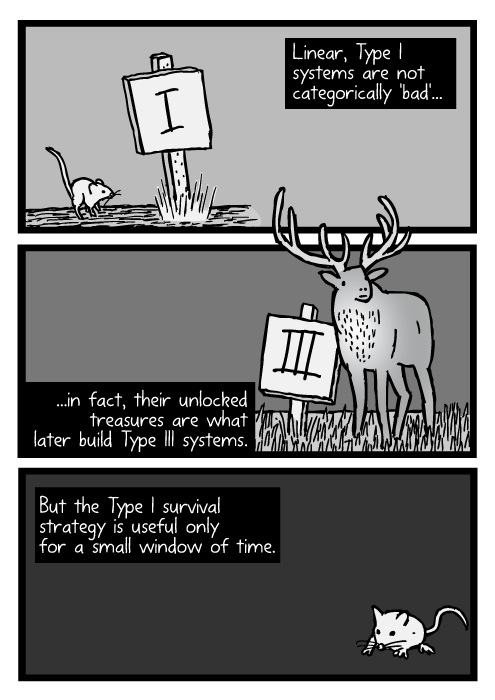
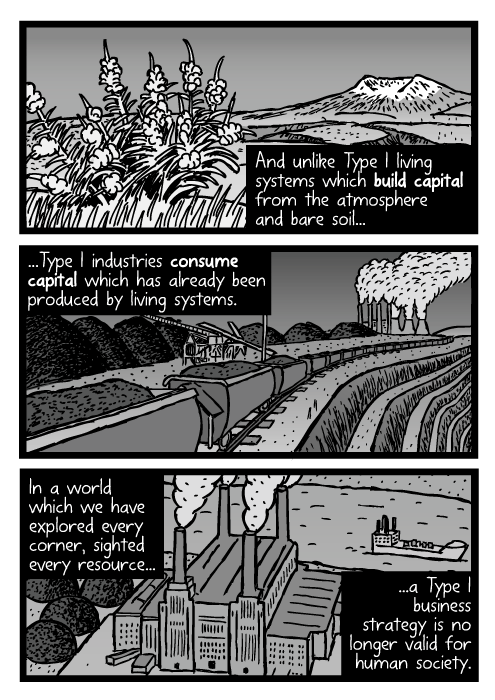


Read some reflections and insights into the Type III comic and the Mount St. Helens ecosystem recovery in the blog section of this website.
Support the artist, and buy a $2 PDF of Type III.
 (cs)
(cs)
 (el)
(el)
 (pt-BR)
 (zh)
(zh)
This website supports three options for navigating through the comic: mouse scroll wheel, left and right keyboard arrows, and touchscreen.


great stuff
Interesting parallel between the natural and industrial system! 🙂
I’d just like to add that the Type III states in natural systems are not designed for indefinite occupation of land but are actually part of a cyclical process of succession over the longer term. As the Type III state is the most fragile stage of the cycle and takes the longest amount to time to form, people tend to place greater value on Type III environments. However, overvaluation of the Type III stage versus the importance of natural timescales for succession between each stage have led to human interference to artificially maintain the Type III state of some natural systems with negative environmental consequences (e.g. the ‘smokey bear’ policy in the USA – http://www.personal.psu.edu/agl/Law%20review%20fire-oak.pdf). A key problem in natural systems is, therefore, not the need to maintain Type III states indefinitely but the blockages that human activities are putting in place that prevent the transition from Type II to Type III states.
Hope, vision, and a map charting a direction to sustainable human being.
Thank you Stuart.
I am a huge fan of your work, they inspire me so much. I love the way you interweave scientific facts with the human society, it is truly amazing.
Pingback: The Great Disruption (moving to Canberra) - Stuart McMillen blog
Brilliant – as an industrial ecologist, I love this!
Pingback: Thin Air reflections - Stuart McMillen blog
Pingback: Type III reflections - Stuart McMillen blog
Awesome! Reppin’ work man ill add your site to my news feed 🙂
Excellent Comic, I will do some advertisement in a social network 😉
great work stu, i’d love to see this as a backdrop in the council marquee for the next greenheart fair… make it happen stu, make it happen
greg
Thanks for the great depiction of natural succession, as a path of ecosystem learning. There’s another key piece of science for it, that can help guide a Type II to Type III transition for an economy. It’s that the resources used in *every phase*, for building the next, is the system’s own surplus products. For economy’s that’s its $savings accounts people accumulate, that are used to pay for the resources invested in building the next form of the system, its creative cycle.
Today $savings are managed only by maximizing the rate of growing $savings, and as a Type III system their purpose of $savings would change from multiplying themselves to securing the economy’s health, and relationships with the other communities it relies on. So, $savings would stop being invested for wealth as that undermines the whole, and is then largely used like endowments, for other values needed for securing the whole.
A full model is: “Adopt natural system principles to keep economies profitable at their limits” http://www.synapse9.com/signals/2012/05/10/natural-principles-to-stay-profitable-at-limits/
Absolutely brilliant! I will be citing this work in my research for The Bionic City – http://www.scoop.it/t/the-bionic-city – as this comic strip has succinctly summarized one of the key principles my hypothesis embeds. Exciting work Stuart, it’s made my day! Will ping it to a few folks I think will be excited about it too, inc the Earth2Hub.com crew.
The ecological portions of this were painful to read. That view of succession is considered quaint and outdated by much of the scientific community.
This is the coolest comic I’ve seen. Just a great look at ecosytems that either we create by design or by default. Inspirational, beautiful and directional.
Pingback: The best comic about industry and ecosystems you’ll ever read | Grist
Your style reminds me of Scott McCloud, very direct and and interesting. Keep up the good work, Stuart!
Nice analogy there Stuart -really liked this one; it’s a complex topic for a cartoon to tackle! Interesting to muse on what a ‘Type 3′ *modern* human civilisation would look like… actually…I think we have already been a type 3, the Australian aborigines’ traditional way of life would probably fit the bill, and I’m thinking back to the ‘conserver’ society my grandmother inhabited, before the advent of the mass-production and consumption we have nowadays -nothing was wasted or thrown out, everything was conserved and reused because to replace it was unaffordable. We can still go back to that way of living if there is the will…but our economies are dependent on the cycle of consumption, and ‘consumer confidence’… what would happen if we stopped spending, consuming (and wasting, prompting the need for more consumtion)?. Recession! Let us know what a type 3 modern human civilisation looks like!